What Burr Formation Tells You About Heat Treatment Quality
Here's the thing: I used to blame my sharpening stones. Every time I dragged a blade across the stone and felt a rough, wire-like lip on the edge, I'd cuss out the grit. Wrong stone. Bad technique. But actually? That little ridge of steel—the burr—was screaming at me about the real problem hiding in the blade's guts. See, burr formation isn't just a side effect of sharpening. It's a live report card on your knife's heat treatment quality. Ignore it, and you're just polishing a turd. Start reading it, and you suddenly know whether your "premium" steel is a hero or a fraud.
What a Burr Actually Is (And Why It Matters)
When you sharpen, you're pushing metal around. Hard. Ideally, tiny bits of steel flake away like snow, leaving two clean planes that meet at a perfect apex. But when the steel isn't up for the task, it doesn't cut cleanly. It folds. That fold is the burr—a literal ribbon of steel hanging off your edge. Now, every blade makes some burr. It's normal. But here's where it gets spicy. A burr that forms instantly, feels thick and gummy, or refuses to flip from one side to the other? That's your first clue something went sideways in the heat treat. Good steel with proper heat treatment quality will let you raise a burr that feels crisp, thin, and predictable. Bad steel? It feels like you're trying to sharpen a stick of butter.
The Burr Size Lie Detector
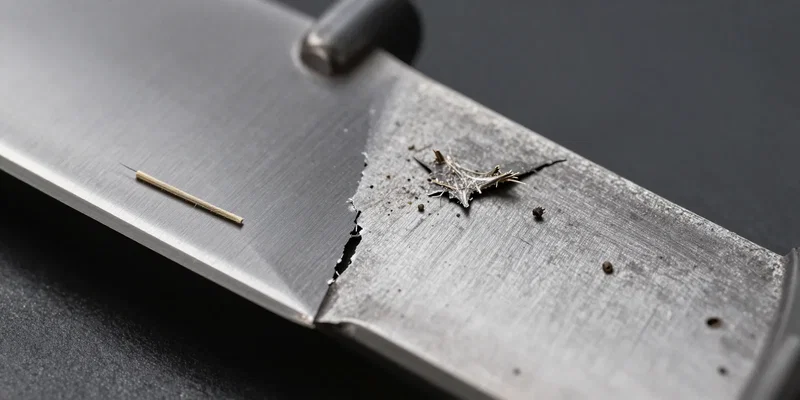
Let's get specific. If you're running a basic carbon steel at 61 HRC, you should be fighting to raise a burr. The steel should be so hard and the carbides so locked in that you have to work for it. But if that same steel rolls over into a massive burr after two passes on a 1000-grit stone? Houston, we have a problem. A huge, floppy burr means the steel is too soft. Full stop. The heat treatment likely failed to hold the austenite in check, or the tempering cycle was too aggressive, dropping the hardness into the dirt. On the flip side, a blade that refuses to form any burr at all and just sparks and chips? You've got the opposite headache. Over-tempered or improperly quenched steel can turn brittle as glass. Neither scenario is a sharpening issue. It's a metallurgy issue. The burr is just the messenger.
Other Clues Your Heat Treat Is Junk
Sometimes the burr doesn't act alone. Watch for its ugly cousins. If you notice micro-chipping while you're trying to form a burr, that's a massive red flag. Chipping during sharpening—before the knife has ever cut a tomato—means the internal stress from the quench wasn't relieved properly. The blade is basically a spring waiting to explode. Another dead giveaway? An inconsistent burr. If it forms thick near the heel but vanishes at the tip, you're looking at uneven heat treatment. Maybe the blade was unevenly heated in the forge, or the quench oil didn't flow right around the geometry. Real talk: a professional heat treatment should give you a uniform steel structure from bolster to tip. If the burr changes personality along the edge, someone cut corners.
Sharpening Diagnostics 101: Read the Burr
So how do you turn this into a real sharpening diagnostics routine? It's stupidly simple. Start with a known stone—something predictable like a 1000-grit ceramic. Use light pressure, maybe ten edge-leading strokes per side. Then stop. Run your fingertip perpendicular to the edge. Not along it, unless you enjoy stitches. Feel for that telltale ridge. Is it uniform? Is it fine and wire-like, or thick and shelf-like? Now, here's the pro move. Flip the knife and do ten strokes on the other side. Does the original burr snap off cleanly and flip to the new side? Or does it just mush back and forth like a limp noodle? A burr that flips with a satisfying, crisp "click" is coming off healthy steel. A burr that just smears around? That's your steel begging for mercy. You can test the entire blade this way. Heel, belly, tip. Map it out. You're not just sharpening anymore. You're inspecting the knife steel like a metallurgist.
Stop Blaming Your Stones
At the end of the day, sharpening is a conversation between you, the abrasive, and the metal. When the metal is lying to you, the burr is the tell. A knife with proper heat treatment quality will sharpen predictably, form a clean burr, and let you refine that edge into something scary sharp. A knife with garbage heat treat will fight you every step of the way, leaving ragged burrs, mystery chips, and a whole lot of frustration. So the next time you're at the stone and things feel weird, don't reach for a different grit. Reach for your knowledge. The steel is talking. Learn the language.